Have you ever received a message with emoji showing teeth 😬 and wondered, “Wait… what does that face actually mean?” I have seen this emoji used in funny chats, awkward situations, nervous replies, and even friendly conversations. At first, it can look like a simple smile, but its meaning is often much more interesting.
The 😬 emoji is commonly called Grimacing Face. It shows a face with a wide, tense smile and visible teeth. Depending on the situation, it can express nervousness, awkwardness, embarrassment, discomfort, or an uneasy reaction.
This emoji is popular because it helps people show feelings that are difficult to explain with words. A short “Okay 😬” can say much more than “Okay” alone.
Like many emojis, the meaning of the emoji showing teeth can change depending on the context, platform, relationship, and conversation. A friend may use it as a joke, while someone else may use it to show genuine discomfort.
In this guide, you will learn the emoji meaning, different emoji meanings, texting examples, social media uses, emoji combinations, and ways to copy and paste 😬.
What Does Emoji Showing Teeth Mean?
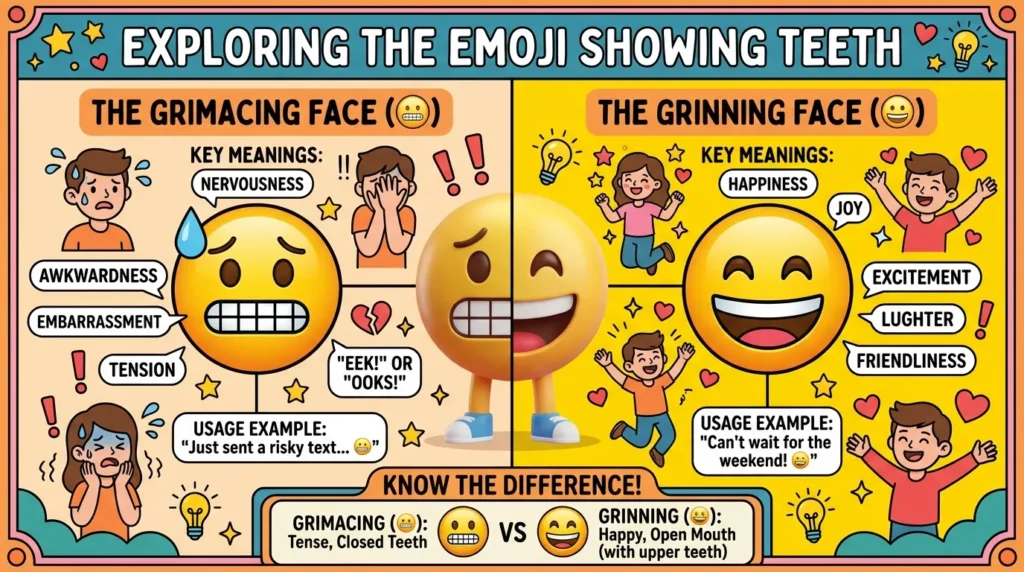
The emoji showing teeth 😬 usually represents an awkward, nervous, embarrassed, or uncomfortable feeling. Its official name is Grimacing Face, and the tightly stretched mouth gives it a tense appearance.
Unlike a normal smiling emoji, 😬 does not usually communicate simple happiness. It often suggests that something feels uncomfortable, strange, embarrassing, or difficult.
For example:
- “I forgot your birthday 😬”
- “I accidentally sent the message to my boss 😬”
- “That was an awkward conversation 😬”
- “I have to give a presentation tomorrow 😬”
The emoji can also show nervous excitement. Someone might write, “My exam results are coming today 😬” to show that they are worried but trying to stay positive.
In casual conversations, 😬 can also soften a potentially uncomfortable statement. Instead of saying something very directly, a person may add the emoji to make the message feel less harsh.
Quick Meaning
😬 = awkwardness + nervousness + discomfort + embarrassment
The exact text meaning depends on what is being discussed.
Different Meanings of Emoji Showing Teeth
The emoji showing teeth can have several meanings. Here are some of the most common ones.
General Meaning
Generally, 😬 represents an uneasy or tense reaction. It can mean “This is awkward,” “I am nervous,” or “I don’t know what to say.”
Romantic Meaning
In romantic conversations, 😬 may show nervousness or shyness. Someone might use it after admitting a crush or making a bold comment.
Example:
“You looked really cute today 😬”
Here, the emoji can suggest nervousness about making the compliment.
Friendly Meaning
Friends often use 😬 when joking about an embarrassing situation.
Example:
“You really thought that was a good idea? 😬”
It can make the message playful rather than serious.
Funny Meaning
The emoji can represent a funny but uncomfortable moment.
Example:
“When you wave back at someone who wasn’t waving at you 😬”
Sarcastic Meaning
Sometimes 😬 is used sarcastically when someone makes a questionable decision.
Example:
“You spent all your money on snacks? 😬”
Social Media Meaning
On social media, 😬 often appears in reactions to embarrassing posts, awkward videos, uncomfortable news, or relatable situations.
Text Message Meaning
In texting, 😬 can mean “I’m nervous,” “Oops,” “That’s awkward,” or “I don’t feel good about this.”
Workplace Meaning
At work, the emoji should be used carefully. With close coworkers, it can show nervousness about a meeting or mistake.
Example:
“Looks like the meeting was moved to 8 AM 😬”
However, it may not be suitable for formal business communication.
When Should You Use Emoji Showing Teeth?
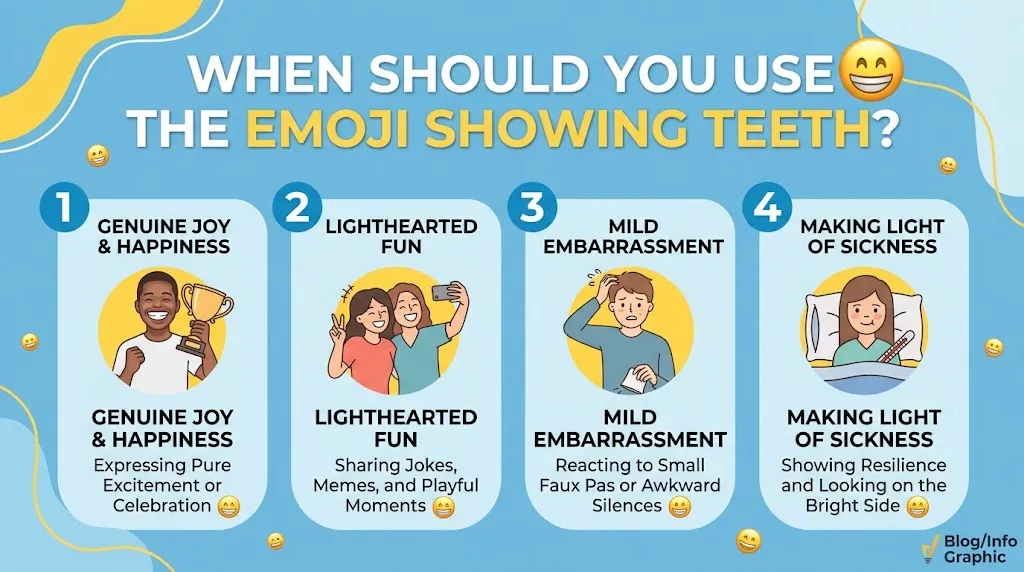
Use 😬 when your message involves nervousness, awkwardness, embarrassment, or an uncomfortable situation.
Good situations include:
- When you make a small mistake.
- When something embarrassing happens.
- When you feel nervous about an upcoming event.
- When a conversation becomes awkward.
- When you want to joke about an uncomfortable situation.
- When you want to soften an awkward statement.
- When you are worried about someone’s reaction.
- When you accidentally say something embarrassing.
Texting Examples
“I think I sent that message to the wrong person 😬”
“My interview starts in five minutes 😬”
“I completely forgot about the homework 😬”
“So… about what happened yesterday 😬”
The emoji works best when the words already provide some context.
What Does Emoji Showing Teeth Mean from a Girl?
When a girl sends 😬, it does not have one fixed meaning. The surrounding conversation matters more than the emoji itself.
She may use it to show nervousness, embarrassment, awkwardness, or playful discomfort.
For example:
“I was going to tell you something… 😬”
This could suggest she feels nervous about what she wants to say.
Another example is:
“I accidentally liked his old photo 😬”
Here, the emoji clearly shows embarrassment.
If she uses 😬 after a joke or teasing comment, it may simply make the conversation playful. Do not automatically assume it has a romantic meaning.
What Does Emoji Showing Teeth Mean from a Boy?
A boy may use 😬 in much the same way. It can show that he is nervous, uncomfortable, embarrassed, or joking about an awkward situation.
For example:
“I have to meet her parents tonight 😬”
This suggests nervousness.
Or:
“I think I made things awkward 😬”
Here, it communicates embarrassment or regret.
In casual chats, a boy may also use 😬 to react humorously to a friend’s bad decision.
The best way to understand the text meaning is to consider the words before and after the emoji.
Emoji Showing Teeth on Snapchat
On Snapchat, 😬 is commonly used in quick conversations, reactions, captions, and replies.
Because Snapchat conversations are often casual, the emoji can express an immediate emotional reaction.
For example:
“That was so awkward 😬”
or
“My teacher just called my name 😬”
Snapchat users may also combine it with other emojis to make the feeling stronger.
😬😂 can suggest something is awkward but funny.
Emoji Showing Teeth on WhatsApp
WhatsApp emojis are widely used for everyday conversations with friends, family, classmates, and coworkers.
On WhatsApp, 😬 can communicate nervousness or discomfort without requiring a long explanation.
For example:
“I forgot to call Mom back 😬”
It can also make an apology sound less formal:
“Oops, I completely forgot 😬 Sorry!”
However, avoid relying on 😬 when discussing serious issues because the recipient may misunderstand your tone.
Emoji Showing Teeth on Instagram
Instagram emojis often appear in comments, captions, DMs, and reactions.
The 😬 emoji can be used when reacting to an awkward video, embarrassing photo, unexpected post, or funny situation.
For example:
“That ending 😬”
This could mean the ending was uncomfortable or unexpected.
In Instagram DMs, it can also soften a teasing message:
“You really posted that? 😬😂”
Emoji Showing Teeth on TikTok
TikTok emojis are often used to react to relatable, funny, embarrassing, or surprising content.
The 😬 emoji can be especially useful for videos showing awkward moments.
For example:
“When you realize everyone heard you 😬”
or
“Me trying to act normal after saying something embarrassing 😬”
TikTok emojis often work together with captions, making the emotional meaning easy to understand.
Emoji Combinations
Emoji combinations can change or strengthen the meaning of 😬.
| Emoji Combination | Meaning |
| 😬😂 | Awkward but funny |
| 😬🤣 | Extremely awkward and funny |
| 😬❤️ | Nervous but affectionate |
| 😬😅 | Embarrassed and trying to laugh it off |
| 😬😳 | Very embarrassed |
| 😬🙈 | Shy or embarrassed |
| 😬😭 | Painfully awkward |
| 😬🤦 | Frustrated by a mistake |
| 😬💀 | Extremely awkward or funny |
| 😬😬 | Strong awkwardness |
| 😬👀 | Nervous curiosity |
| 😬🤔 | Unsure or uncomfortable |
| 😬🙏 | Nervous apology or request |
| 😬🔥 | Nervous about something exciting |
| 😬🥲 | Smiling through an uncomfortable situation |
| 😬👍 | Reluctant agreement |
The surrounding text still matters. An emoji combination can have different meanings between friends, couples, coworkers, and strangers.
Copy and Paste Emoji Showing Teeth
Want a quick copy and paste emoji? Here are several versions you can use.
😬 Copy
😬😬 Copy
😬😂 Copy
😬❤️ Copy
😬😅 Copy
😬🙈 Copy
😬😭 Copy
😬💀 Copy
😬🤦 Copy
😬👍 Copy
Simply select the emoji combination you want and paste it into your message, caption, comment, or social media post.
Similar Emojis
Several emojis can look or feel similar to 😬, but each has a different emotional tone.
| Emoji | Name | Meaning | Difference |
| 😀 | Grinning Face | Happiness | More openly happy |
| 😃 | Grinning Face with Big Eyes | Cheerfulness | More positive |
| 😄 | Grinning Face with Smiling Eyes | Joy | Warmer and happier |
| 😁 | Beaming Face | Excitement | Confident, happy grin |
| 😅 | Grinning Face with Sweat | Nervous relief | Adds a sense of relief |
| 😂 | Face with Tears of Joy | Strong laughter | Clearly humorous |
| 😳 | Flushed Face | Embarrassment | More visibly shocked or shy |
| 😰 | Anxious Face with Sweat | Anxiety | Stronger worry |
| 😨 | Fearful Face | Fear | More serious fear |
| 😣 | Persevering Face | Struggle | Shows difficulty or frustration |
| 🙃 | Upside-Down Face | Irony | Often playful or sarcastic |
The main difference is that 😬 has a tight, uncomfortable grin, making it especially useful for awkward situations.
Emoji Appearance Across Platforms
The exact appearance of 😬 can vary slightly between platforms. The basic idea remains the same, but facial shape, eyes, teeth, and expression may look different.
Apple
Apple’s design typically presents 😬 with a clear row of teeth and a tense facial expression. It can look strongly awkward or nervous.
Android
Android versions may have slightly different facial details depending on the device and operating system version.
Samsung
Samsung’s emoji design can use its own visual style, so the expression may appear somewhat different from Apple’s version.
Windows
Windows displays emojis with Microsoft’s visual design. The overall emotion remains recognizable even when the artwork changes.
Facebook may display its own rendering of the emoji depending on where the emoji is being viewed.
WhatsApp emojis can have a distinct appearance compared with other platforms. This means the same 😬 emoji may look slightly different when sent between devices.
These visual differences usually do not change the basic emoji meaning.
Fun Facts
Here are eight interesting facts about the emoji showing teeth:
- 😬 is officially known as Grimacing Face.
- Its expression is based on a tense, toothy grin.
- It is often associated with awkward or uncomfortable moments.
- The emoji can communicate feelings without a full sentence.
- Its meaning can change based on surrounding text.
- Different platforms may display the same emoji differently.
- It is commonly used in casual digital conversations.
- Combining 😬 with other emojis can create a more specific emotional message.
Common Mistakes
One common mistake is assuming 😬 means “happy.” Although the emoji has visible teeth, its expression is more tense than cheerful.
Another mistake is confusing 😬 with 😁. The 😁 emoji usually represents a happy or excited grin, while 😬 often suggests awkwardness or discomfort.
People also sometimes assume 😬 always means embarrassment. It can also represent nervousness, sarcasm, uncertainty, or an uncomfortable reaction.
Using 😬 in a serious workplace conversation can create confusion. If the topic is sensitive, clear words are better than relying only on an emoji.
Finally, do not interpret the emoji by itself. Always look at the entire conversation before deciding what someone means.
FAQs:
What does the emoji showing teeth mean?
The emoji showing teeth 😬 usually represents an awkward, nervous, embarrassed, or uncomfortable feeling. It can mean “This is awkward,” “Oops,” or “I’m nervous.” The exact emoji meaning depends on the conversation, relationship between the people, and surrounding words.
What is the official name of 😬?
The official name of 😬 is Grimacing Face. It shows a face with a tense expression and visible teeth. People commonly use it to communicate awkwardness, nervousness, embarrassment, discomfort, or an uneasy reaction in digital conversations.
Is 😬 a happy emoji?
Not usually. Although 😬 has visible teeth, it generally does not mean simple happiness. A happier toothy expression is often represented by 😁 or 😄. The grimacing face usually suggests tension, awkwardness, nervousness, or discomfort.
What does 😬 mean in texting?
In texting, 😬 can mean “That’s awkward,” “I’m nervous,” “Oops,” or “I feel uncomfortable.” It can also soften an embarrassing statement or make a difficult message feel more casual. The surrounding text is important for understanding its exact text meaning.
What does 😬 mean from a girl?
When a girl sends 😬, it may indicate nervousness, embarrassment, awkwardness, or playful discomfort. It does not automatically indicate flirting or romantic interest. To understand her intention, consider the conversation, her wording, and the relationship between you.
What does 😬 mean from a boy?
A boy may use 😬 to show that he feels nervous, embarrassed, awkward, or uncomfortable. It can also be a humorous reaction to a friend’s mistake. Like most emojis, its meaning depends on the specific situation rather than the sender’s gender.
What does 😬 mean on WhatsApp?
On WhatsApp, 😬 is commonly used in casual chats to show nervousness, awkwardness, embarrassment, or discomfort. Someone might send it after making a mistake, receiving unexpected news, or discussing an uncomfortable situation. WhatsApp emojis can also be combined with other emojis for extra meaning.
What is the difference between 😬 and 😁?
The main difference is emotional tone. 😁 usually shows happiness, excitement, or a cheerful grin. 😬 has a tense expression and is more often connected with awkwardness, nervousness, embarrassment, or discomfort. They may look similar because both show teeth, but their meanings are different.
Conclusion
The emoji showing teeth 😬 is much more than a simple smile. Its tense grin can communicate awkwardness, nervousness, embarrassment, discomfort, uncertainty, or even playful sarcasm.
The most important thing to remember is that emoji meanings depend on context. A message from a close friend may have a completely different tone from the same emoji used in a workplace conversation.
If you’re using WhatsApp emojis, Instagram emojis, TikTok emojis, or ordinary text messages, 😬 can be a useful way to show an uncomfortable reaction without writing a long explanation.
So, the next time you see 😬, look at the words around it before deciding what the sender means. And when you use it yourself, choose the situation carefully so your intended emotion is clear.

I am Ryan Mitchell, the author and creator of EmojiInsight.com, a helpful website dedicated to explaining emoji meanings, interpretations, symbols, and everyday digital expressions. At EmojiInsight.com, I share simple and easy-to-understand insights to help readers better understand what different emojis mean and how they are commonly used in texts, social media, and online conversations.